TRIP TO ANDAMAN AND NICOBAR ISLANDS
India
offers a very wide variety of places of tourist interest which can
satisfy almost everyone who is looking for leisure, education,
history or fun time. While I have had the opportunity to travel to
almost every state in the country by now, a trip to the Andamans was
due.
The
Andamans, (short for Andaman & Nicobar Islands) a
Union
Territory, consists of 836 islands grouped into two island
groups, the Northern Andaman
Islands and the Southern Nicobar
Islands, of which only 31 are inhabited.
The
weather in the area throughout the year is rather hot since it is
located in the belt of 6°
to 14° North latitudes.
The
islands have a
tropical
climate with warm summers and not so cool winters, typically the
temperatures around the year average from 23°C to 31°C.The rainfall
is dependent on the monsoons
and tropical
cyclones are common in late summer. The ideal time to visit the
islands thus reduces to the period of December
to March and the time to definitely avoid is the Monsoons.
Port
Blair is now well connected by air, and a number of airlines operate
flights to Port Blair. Port Blair has a modern airport terminal too.
The airport is named Veer
Savarkar International Airport.
International flights are yet to commence, may be due to some
regulatory reasons.
First
view of the Island
One
of the things to remember while planning a trip is that the time of
arrival in Port Blair and other places dictates the programme and the
number of days necessary to get a good idea of life in the Islands.
Also, movement between the islands is on a ferry which has fixed
timings and its good to book tickets well in advance lest one has to
spend an additional day just to move from one island to another. The
movement of the ferries is of course subject to weather and sea
conditions.
With
all this in mind, we decided to go there in end January 2024, made
our reservations for air travel, the hotels/resorts and ferries prior
to the travel and divided the trip into 3 parts
Port
Blair and Southern Andaman - 3 nights
Swaraj
Dweep (earlier Havelock island) - 3 nights
Shaheed
Dweep (earlier Neil island) - 2 nights
Port
Blair and Southern Andaman
We
traveled from Pune, hence we had to take a flight to Bengaluru and
from there boarded a flight to Port Blair. Immediately on arrival at
Port Blair at around 2.30 PM, we were picked up by a prearranged
dedicated cab.
After
a brief discussion with the driver who was also our local guide, we
headed straight to the Cellular Jail about which I had read for the
first time in Veer Savarkar’s autobiography in Marathi माझी
जन्मठेप while in School. The description
of his life in that jail, while undergoing a sentence of 50 years of
RI had made a lasting impression on me. For entry into the Cellular
Jail, there’s an entrance ticket for the visit, its also good to
engage a guide who conducts groups through the jail. It was mainly
the revolutionaries, many of them remain nameless for lack of
records. who were sent to this far off jail for the more severe
forms of sentences. The inhuman and unbearable conditions in which
these ‘prisoners’ were confined in their solitary cells without
any contact with each other, can be imagined only after a visit to
the jail. The cells occupied by the revolutionaries, the place where
they were made to extract oil from coconuts and were punished with
lashes for failing to meet the impossible targets and worse, the
gallows where some were hung, have left a very vivid impression which
Veer Savarkar had very lucidly written about in his book. The visit
to the cell he stayed in was also very moving. It involves a walk up
to the cell which is on the second and top floor, everyone may not be
able to undertake it.
At
night, there’s a Sound and Light Show of 50 minutes or so, in fact
3 sessions of them, which explains the entire significance of the
Cellular Jail and the life the revolutionaries led there. Its a very
moving experience, one cannot leave without shedding a tear and
paying homage to the Revolutionaries. Tickets need to be purchased,
the seating arrangement is good, seat numbers are allocated on the
tickets. The only jarring note was that many over enthusiastic
visitors click videos of the Show which disturbs others, the
Administration would do well to curb this activity. One of the major
reasons for visiting these islands for many, is the visit to the jail
to pay homage to the revolutionaries. Its a place not to be missed.
A
view of the Cellular Jail at night
We
had checked into the Hornbill Resort which was closeby. While the
Resort is good, offers a fantastic view of the sea, going to the
Rooms involves going down and up a number of steps, not easy for
everyone. After spending the night there, on our second day, we
planned to go to a place called Baratang Island, 110 kms away, from
where we were to take a ride in a motor boat, called speed boat,
through mangroves and see a limestone cave.
For
going to Baratang, there are fixed timings for the convoys which are
escorted by the police since the route goes through Jarawa Reserves,
the tribals inhabiting the area are yet to be integrated into others
way of life and are at times known to harass the visitors. We took
the convoy which leaves around 9 AM from a place called Jiraktang,
which itself is around 40 kms from the town. There’s a speed limit
of 40 kms/hr for the journey hence the whole trip takes almost the
whole day to complete. The move back is also at fixed times. One of
the highlights of the trip to Baratang is the expectation that one
would see some Jarawas by the roadside but we were not so lucky.
At
the end of the road journey, there’s a 10 minute ferry ride to
cross over to the Baratang Island from where speed boats take you on
a ride through the mangroves and to the limestone cave. The Cost of
the speed boat is 9000 per boat, till the ferry site, everyone moves
in their cabs and the drivers organise the sharing of the boat trip,
thus the cost per head turns out to be Rs 900 per head. The 20 minute
ride to the limestone cave is nice and worth it, reaching the
limestone cave itself involves a walk of about 1.2 kms and is easy to
undertake. The cave isn’t very big or deep and may disappoint those
who may have seen such caves elsewhere. Prior to the return journey,
lunch is generally to be had on the island, the facilities though not
as modern as one may expect, are hygienic and clean and one can get
reasonably good food, both vegetarian and non vegetarian, at a
reasonable price. By about 6 PM, we reached our resort. This trip may
be avoided by those who are short of time as it doesn’t have much
to offer.

The Ferry
The
Limestone Cave
On
Day 3, we went to Wandoor Beach and also visited a museum located
very close to it. The museum is small but gives a good idea and
information about corals. The Beach itself is clean, nice with not
too many visitors. This could be because the aquatic area is fragile
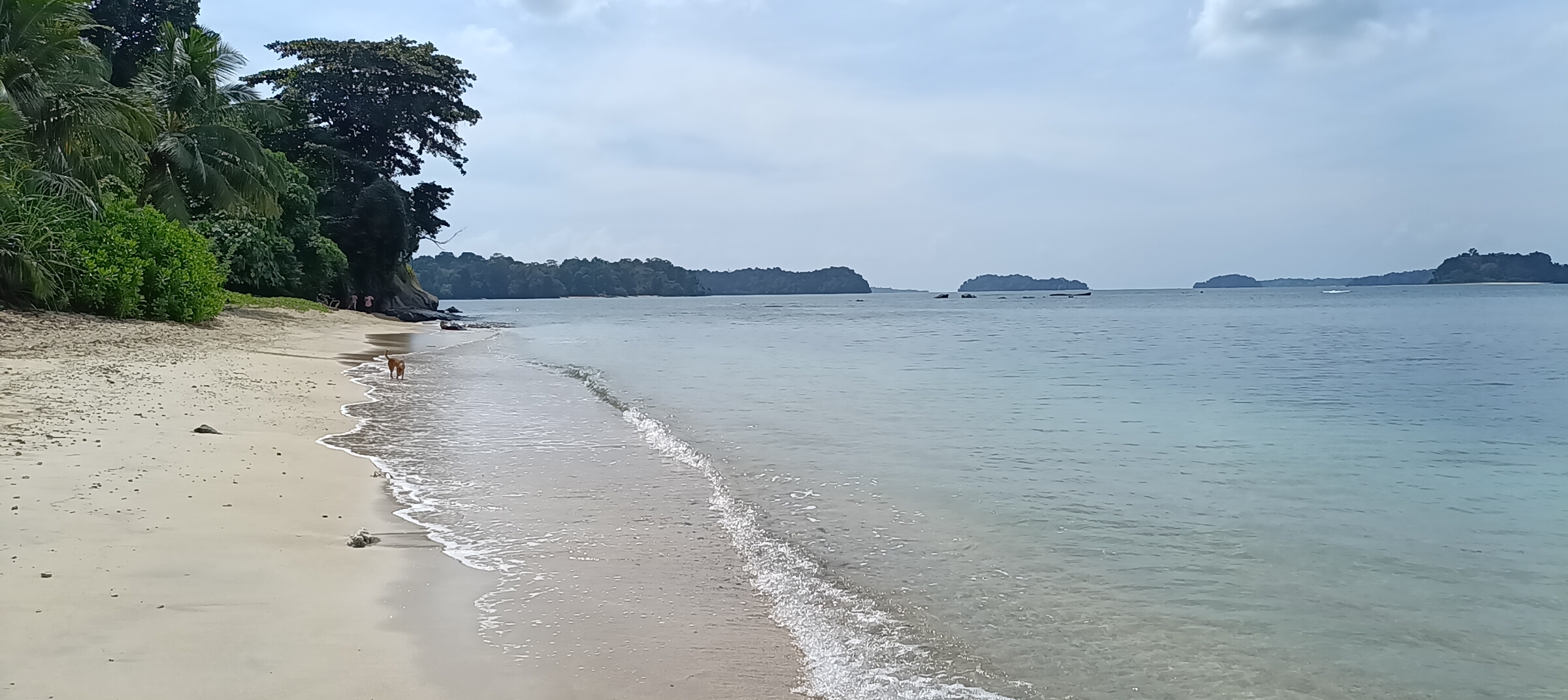
and protected, no activities are permitted there. The view of the sea
from here is breathtaking though, the water is clear with many
different hues of blue/green.
The
Wandoor Beach
While
the view is great to spend some time, the same thing would get
repeated in the islands which are being visited in the next few days.
We had lunch there at a Resort close by. After some rest at our place
of stay, the evening was for a trip to the Chidiya Tapu to watch the
sunset. Enroute, we also spent some time at the zoo which is
elementary although the trees and fauna are worth a look. The Zoo
also provides electric carts for movement within, making it that much
easier to go around.
The
Chidiya Tapu gets crowded by the time sunset is due as almost
everyone who is in Port Blair lands there and the sunset doesn’t
disappoint either. Its a breathtaking view, worth the wait and
travel. Just hope that the weather holds out and doesn’t spoil the
fun.
The
Sunset
Swaraj
Dweep
On
Day 4, we were to move to Swaraj Dweep by a ferry. There are 2
companies which run ferries, Makruz and Nautika, both are similar.
The ferries are comfortable and well equipped. The check in at the
jetty is almost on the lines of an airport, security check and all
that, so be prepared to reach the area at least 45 minutes prior to
the departure. All luggage also goes along, the existing system works
well but could do with a bit of modernity in handling. The ferry ride
is for about 90 minutes, we had a near perfect ride in it. With that,
the Port Blair part of the trip was over, except the return to the
airport to catch the return flight.
We
arrived at Swaraj Dweep around 9.30 AM, were received by our
designated cab driver and checked into another Govt run Resort,
Dolphin. There’s a bit of a walk with luggage involved here, as you
reach the parking area.
The
Resort was comfortable and catered for everything. The rooms here
were double storeyed, we were allotted the upper floor and offered a
good view of the sea. The property is right next to the sea, not much
of a beach though, and the sea is clear with hues of blue. The
property is quite huge and there’s adequate area to walk/laze
around. Although the food here was good, we found a small restaurant
just about 150 mtrs away which served local food and the food there
too was excellent. In the afternoon, we made a trip to Radhanagar
beach and spent the night back at the Resort.
The
views from the Resort
On
the Day 5, we were scheduled to make a trip to the Elephant beach
which has all the water sports activities and the ride to see the
corals, but late in the evening of the first day, we were informed
that due to the rumoured sighting of a crocodile, the Elephant beach
wasn’t considered safe and hence wasn’t open for tourists that
day. As such, we had to stay at the Resort for the day. We spent the
day exploring the island and going to the Kala Pathar beach in the
evening which was close by, not very big or impressive. The highlight
of the beach is that getting into the sea is permitted at this beach,
it also has many shops selling curios etc. One of the important
lessons learnt was that its good to hire a bike/scooter for
sightseeing rather than a cab. 2 wheelers are available at convenient
locations everywhere, if you are confident and intend to hire one,
make sure to carry your driving licence and follow the traffic rules,
including wearing of helmets by both the rider and the pillion.
Drunken driving invites strict punishments and heavy fines. We found
the traffic discipline and ensuring of adherence by the police,
exemplary all over the Union Territory.

The Sunset photos
It
was around 9 AM on Day 6 (our third in Swaraj Dweep) that we got to
know that the Elephant beach was now safe for travellers and
accordingly we headed to the jetty to go to the beach. The jetty is
rather disorganised and cramped for space. There are many stalls
which sell tickets for the ride to the Elephant beach and the various
adventure activities. All of them charge the same. The redeeming
factor is that even if you purchase the coupons for adventure
activities but for some reason don't undertake them, the money is
refunded on return. By the way, the coupons for such activities can
also be purchased at the Beach at the same rates and with similar
conditions. The only thing to remember is that there’s no mobile
network coverage in the Beach, hence all payments there have to be
made in cash.
The
speed boat takes 10 people and one has to wait for the boat to fill
up, not too long though. The journey is about 40 minutes and nice and
easy. Our captain of the boat was one Pranab Mukherjee or so he
introduced himself and was witty. He regaled us with stories of his
years of plying the boat in the area as well as telling us about what
to expect and do at the Beach. At the small and constricted Beach
there are a whole lot of tourists who come in for the adventure.
There's a time of 3 hours given for the various activities after
which you return in the same boat that you came in. At the Beach, you
find very many activities taking place like jet skiing, parasailing,
banana boats, sofa rides, Octopus ride and what have you. Also the
boat ride, with a glass bottom, to see the corals. There’s also the
option of a “submarine” ride, where you are under the water
although the boat isn’t. Each of the activities here costs between
Rs 600 to 800, the submarine ride is quite costly. There’s also the
snorkeling, where after initiation into it, one is taken to the area
of the corals, its generally restricted to age group between 14 to
70. At the Beach, toilets and bathing areas are provided as also
lockers to keep your belongings and a room for change of clothes, all
on cash payment.
We
had opted for the glass bottom boat ride and a sofa ride. The glass
bottom boat ride can very well be said to be the highlight of the
visit. The view of the corals and the variety of multi coloured fish
under the boat is breathtaking and a must when one goes to the
islands. Thereafter, we undertook what was the Sofa ride in which we
were tugged behind a speed boat as if seated, actually almost lying
down, on an inflated ‘sofa’, it was quite an adventure and we
were holding on to the supports for dear life. After that I even had
a ride on a jet ski, my first one. That too was very adventurous.
After about 2 hrs, all of us had completed all that we set out for
and we got back to the jetty for our return and the last day at the
island.
The adventure sports boats/equipment
Shaheed
Dweep
The
next day, Day 7, we boarded the Nautika Ferry for the Shaheed Dweep.
The process of getting into the ferry is simpler and smooth. At the
Shaheed Dweep, there’s a longer walk to the parking area but there
are cycle rickshaws available to take the luggage up to the cabs.
They generally charge Rs 100 and combine the luggage of many
passengers.
Here
we checked into Sea Shell Resort which has a private beach of sorts
and is a high end luxury resort. Has all the trappings, swimming
pool, spa et al. Food is good.
This island is known for its serene
and pristine environment, and is a popular destination for a
tranquil getaway. The beaches have white sand shores and
crystal-clear turquoise waters. The beaches are called Laxmanpur
Beach, Bharatpur Beach, and Sitapur Beach and are all located close
to the Resort. On this island, one can enjoy sunbathing, swimming, or
just take long walks along beautiful beaches, watching the
sunrise/sunset. The waters surrounding the island are rich in coral
reefs and marine life.
Views from the “private beach”
We went to the Laxmanpur Beach by
cab to laze around and watch the sunset. Almost every tourist on the
small island seemed to have headed there. The sunset was spectacular.
After sunset, we went to the shops nearby which sell curios, food
items and local delicacies.
The Sunset
On Day 8, our second day at the
island, we went to the Sitapur beach, early morning to watch the
sunrise. There was a crowd of about 100 of us, not everyone likes to
wake up early to watch the sunrise. The sunrise was worth all the
trouble though. Thereafter, we went to the Laxmanpur Beach 2, also
called Natural Beach, it has a Natural bridge made of coral reefs
over the ages. One must go there during low tide, thats the time that
one gets to walk among the corals. We were lucky to see the corals
and fish swimming about in the water. It involves quite a walk over
the corals and one needs to be ready for it. Our guide was the one
who showed us the places where such corals and fish were, without a
guide, one may miss out on this part except seeing the corals.
The Sunrise from Sitapur Beach
The Natural Bridge
The Coral in the shallow water during low tide

These fruits are used to make heady spirits
After a hefty breakfast, we set out
again to the jetty area for another ride in a glass bottom boat on
this island. Dare say, the corals here are in greater abundance and
are a delight to watch, although most tourists give it a miss since
they may have already seen it at Elephant Beach. Other sports
activities are also available but not many people undertake these.
We returned to the Resort for some
well deserved rest after the hectic trip over the last week or so. In
the evening, couldn’t resist walking down to the Sunset point to
have another look at the sunset though, it was that close by. Here
again, it may be better to hire 2 wheelers rather than a cab.
The last Sunset in Shaheed Dweep
Back
home
After
spending 8 days in the islands, it was time to get back home. We
boarded the Nautika ferry to Port Blair, after some shopping in Port
Blair on the way to the Airport, we boarded the flight to Bengaluru
and then to Pune.
The
Andaman trip was excellent and is a must for all those who love to
travel. The beaches are clean, unlike most other beaches in our
India, the waters are pristine and of many hues and the people are
very friendly and go out of their way to make you comfortable.